Somewhere far away, a church bell is ringing. In a potato field at the end of the day, a man takes off his hat. A woman puts her hands together. The fork is planted in the earth, the basket and the wheelbarrow wait beside them, and for a moment nobody works.
That's all. And it became one of the most famous paintings in the world.
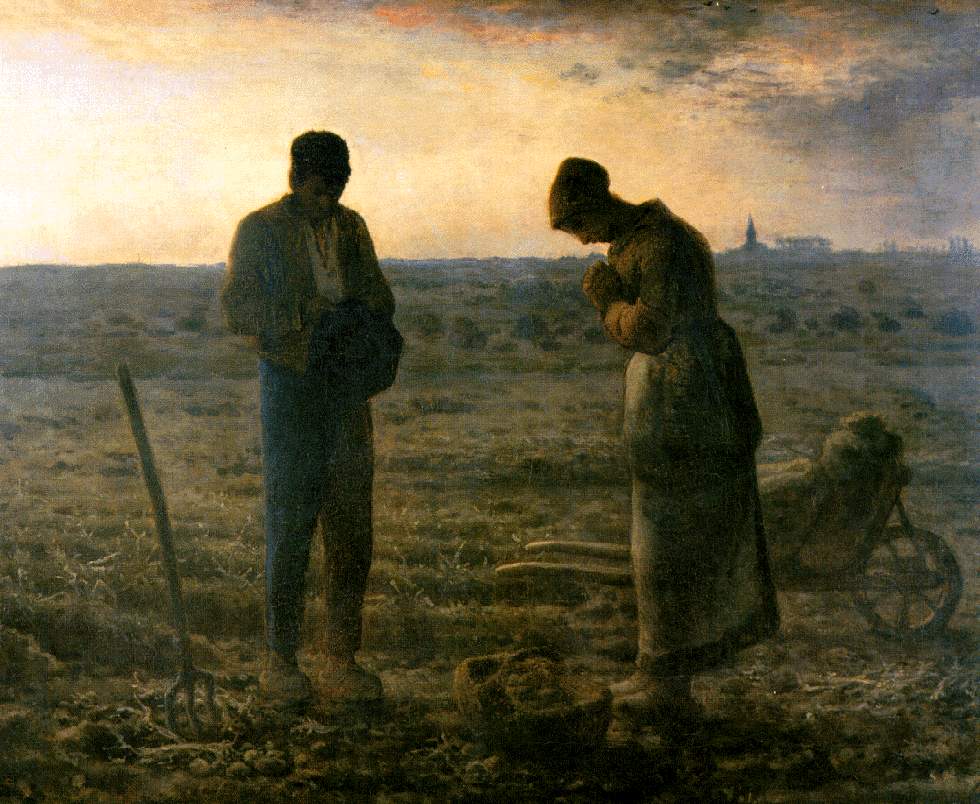
Jean-François Millet, The Angelus, 1857–1859. Musée d'Orsay, Paris
The bell that stopped the day
The Angelus is a prayer traditionally said three times a day, morning, noon and evening, when the church bell rings. For centuries in rural France, it divided time: you stopped, whatever you were doing, and then you carried on.
Millet grew up in a farming family in Normandy. He said the painting came from a memory of his grandmother, who never failed to stop working and pray for the poor dead when she heard the bell.
A painting worth a fortune
The American who commissioned it never collected it. Thirty years later, in 1889, the Louvre and an American art association fought over it at auction until the price reached more than half a million francs, and the painting sailed to America. A year later, a Parisian collector, Alfred Chauchard, bought it back, and on his death left it to France.
Dalí's obsession
The painting haunted Salvador Dalí. He was convinced the couple weren't praying but mourning, and that the basket at their feet hid a child's coffin. At his request, the Louvre X-rayed the canvas. It revealed a dark, oblong shape painted over beneath the basket.
Was it a coffin? Most experts don't think so. But it's impossible to look at the painting quite the same way afterwards.
Your own Angelus
You don't need a bell or a prayer to borrow the idea.
- Choose one time of day: 12 o'clock, 6 o'clock, the moment you close the front door behind you.
- When it comes, stop whatever you're doing. Put the pen down, let go of the bag.
- Lower your head slightly, like the woman in the painting, and take three slow breaths.
- Think of one person, alive or not, and wish them well.
- Then carry on.
It's the same idea as a morning ritual built around a single object: small, repeated, and stronger than it looks. And if rural France speaks to you, Monet painted the same haystacks again and again.
A pause that arrives every month
"(letters) On Art" brings a letter and a postcard to your door every month, with the seasonal printed issue of "(meditating) On Art". A small ring of the bell, through the letterbox.
Remember to take as much time as you need, and meet me at the next one.
Love, Evi