
Twelve tabs open. Three tasks half-finished. A message you meant to answer an hour ago. When your attention is scattered like this, trying to "focus harder" rarely works. What helps is giving your eyes one thing worth staying with.
These four paintings were made with extraordinary concentration. Spend a few minutes with one of them, and some of that focus finds its way back to you.
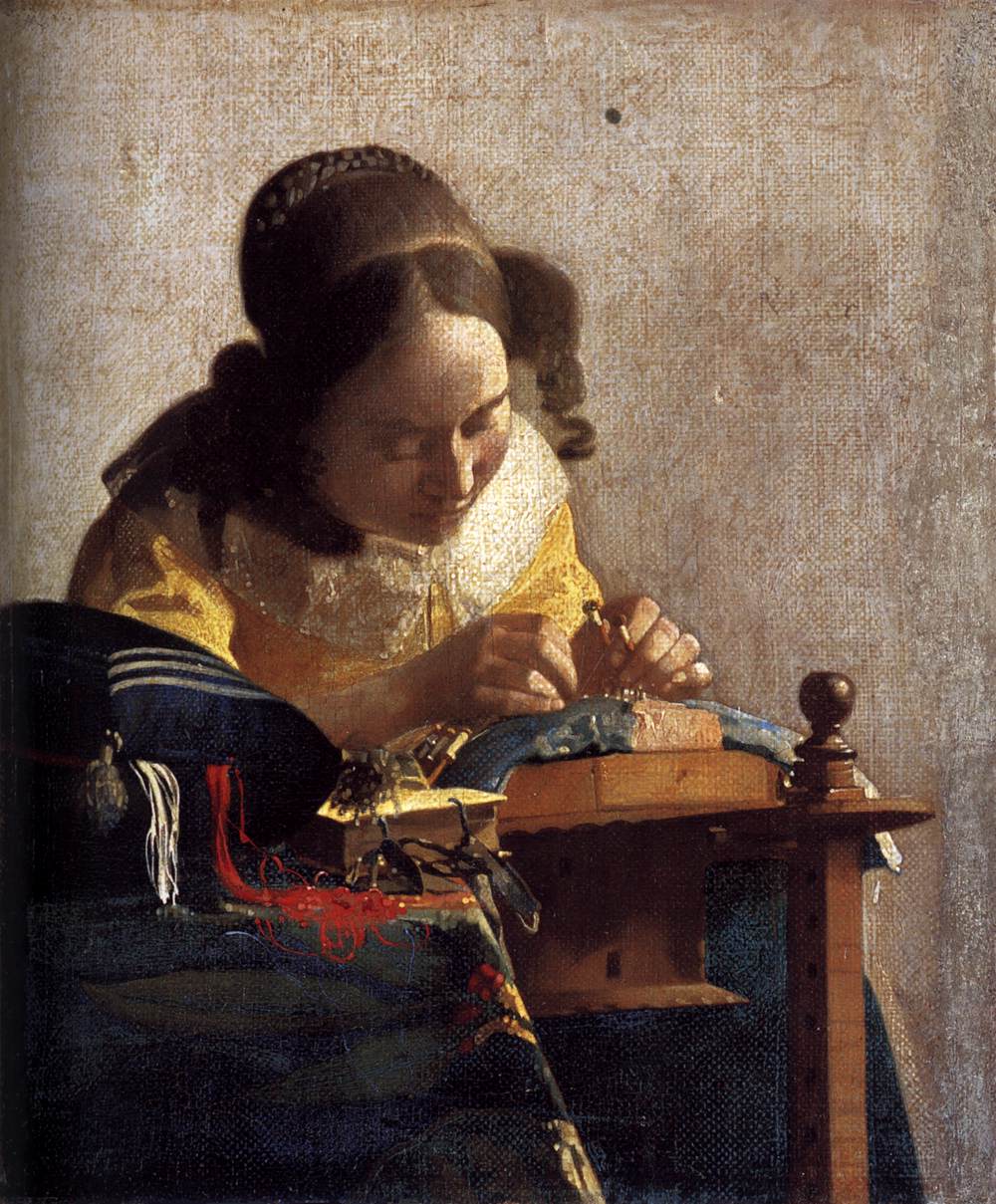
Johannes Vermeer, The Lacemaker (c. 1669–70, Louvre, Paris)
One of the smallest paintings in the Louvre, barely larger than a sheet of paper. A young woman bends over her work, entirely absorbed. Look at her hands, painted with precision, then at the red and white threads spilling from the cushion in the foreground, painted soft and almost liquid. Vermeer shows us what focus looks like: everything sharp where her attention is, everything else allowed to blur.
Jean Siméon Chardin, Soap Bubbles (c. 1733–34, several versions, including the Metropolitan Museum of Art)
A young man leans from a window ledge, blowing a bubble through a straw. A small child peeks over the edge to watch. The bubble is about to grow, or to burst. The whole painting holds its breath. Attention, Chardin seems to say, is just as fragile, and just as beautiful.

Albrecht Dürer, Young Hare (1502, Albertina, Vienna)
A watercolor of a hare, and every single hair seems to have been painted one by one. Look closely at its eye: a tiny window is reflected there, the window of the room where it was painted. Dürer looked at this animal so carefully that he caught the light in its eye.

Georges Seurat, A Sunday on La Grande Jatte (1884–86, Art Institute of Chicago)
Up close, this enormous painting dissolves into thousands of tiny dots of color. Step back, and they become a calm Sunday afternoon by the Seine. It's a perfect image for a scattered mind: what looks like chaos up close can become a picture once you take a step back and breathe.

How to use them
Choose one painting. Set a timer for five minutes. Pick a single detail, a thread, a bubble, a hair, a dot, and look at it as if it existed on its own. Each time your mind wanders, return to it. That's the whole practice.
Keep the souvenir
If you'd like to remember the paintings that help you, The Collector's Diary is a free printable journal with a short guided meditation. Its prompts ask what you noticed first, what your senses took in and how a work made you feel. One page per painting, and your scattered days gain a quiet anchor.
Remember to take as much time as you need, and meet me at the next one.
Love, Evi