
At first glance, all you see is a burst of pink, something between the frosting on a cupcake and a peony in full bloom, floating in a dark green garden. Look a little closer and the froth becomes a young woman on a swing, mid-flight, one shoe sailing through the air.
You've almost certainly seen it, or one of the countless images it inspired. Fragonard's The Swing is one of the most recognisable paintings of the 18th century. Its story is a little less innocent than it looks.
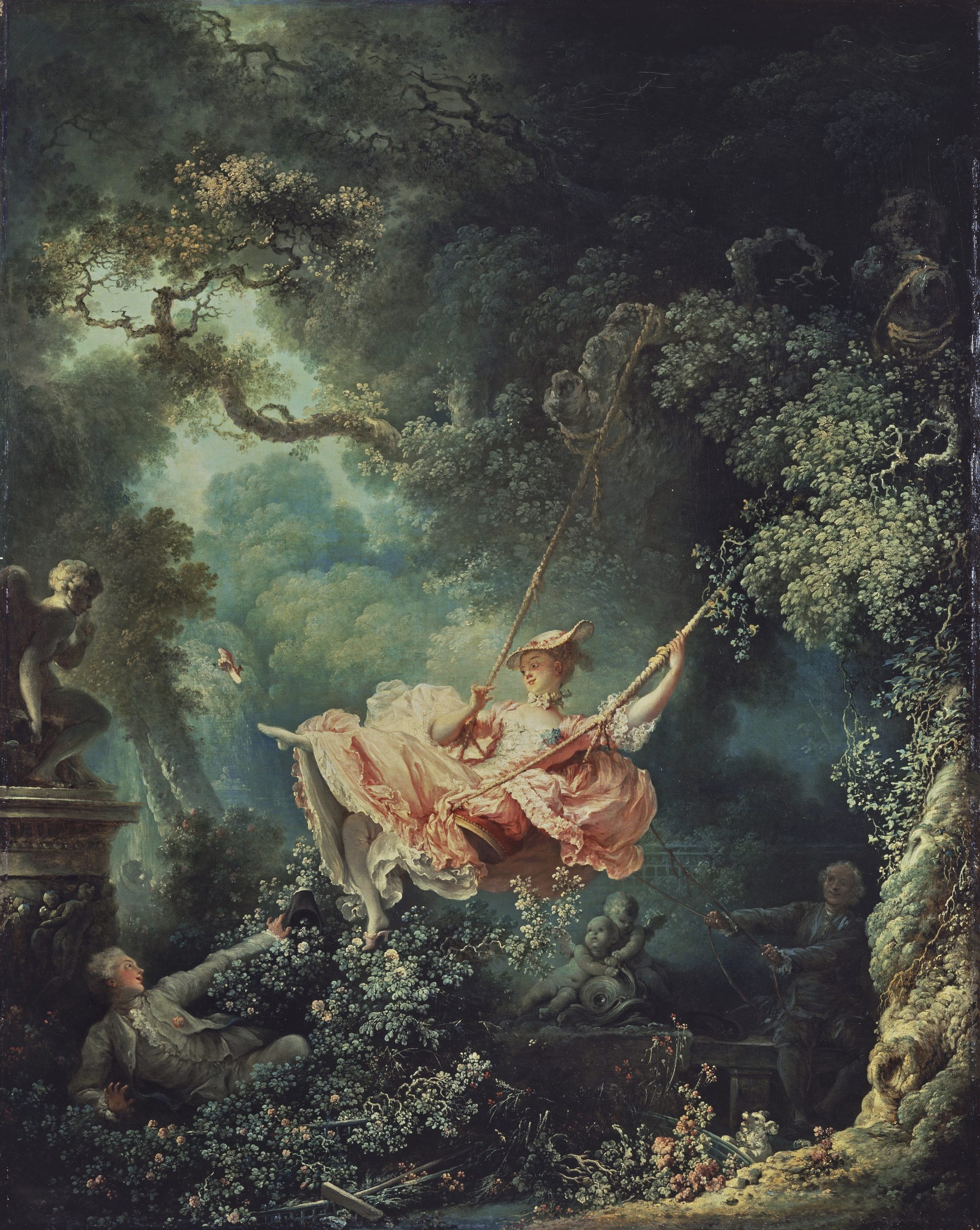
Jean-Honoré Fragonard, The Swing, about 1767–1768. The Wallace Collection, London
The commission
According to the memoirs of the playwright Charles Collé, a gentleman of the court first approached another painter, Gabriel-François Doyen. He wanted a picture of his mistress on a swing, pushed by a bishop, with himself placed below where he could see her legs. Doyen found the idea too frivolous and passed it on to Fragonard.
Fragonard took it, with one change: the man pushing the swing is not a bishop but an older man, half in shadow. Collé never named the client, so the story remains an anecdote rather than a certainty. But it explains the young man in the roses, his arm outstretched, his hat in his hand.
The details that tell the story
- The shoe, kicked off at the top of the swing, flying towards a statue.
- A statue of Cupid on the left, a finger raised to his lips: hush.
- Two small cherubs beside the older man, one of them looking up at the scene.
- The light, falling like a spotlight on the pink dress, while everything else stays in shadow.
Look at it as if for the first time
- Before reading anything more, let your eyes move freely across the painting for a minute. Where do they go first? Where do they keep coming back?
- Close your eyes for two breaths. Straighten your spine.
- Open them and look at one part at a time: the dress, the shoe, the hidden man, the statue, the dark trees. Imagine your gaze absorbing the colours and the light.
- Breathe deeply. Close your eyes once more and notice how you feel. Any emotion, any sensation, even if it seems to have nothing to do with the painting.
You may find it funny. Or a little uncomfortable. Both are honest answers. For more about women painters of the same century, here are five women who painted in 18th-century France, and for more secrets, hidden details in famous paintings.
Keep the paintings that surprise you
The Collector's Diary is a free printable zine for remembering your encounters with art: where you met a painting, what you noticed first, and how it made you feel.
Remember to take as much time as you need, and meet me at the next one.
Love, Evi