Pale mist on a lake. A great tree leaning over the water, its leaves dissolving into the sky. On the left, a smaller, bent tree, and beneath it a woman and two children, reaching up as if to gather something from its branches.
Everything is soft, silvery, slightly blurred. As if you'd seen it once, long ago, and could almost remember it.
That's exactly the point.
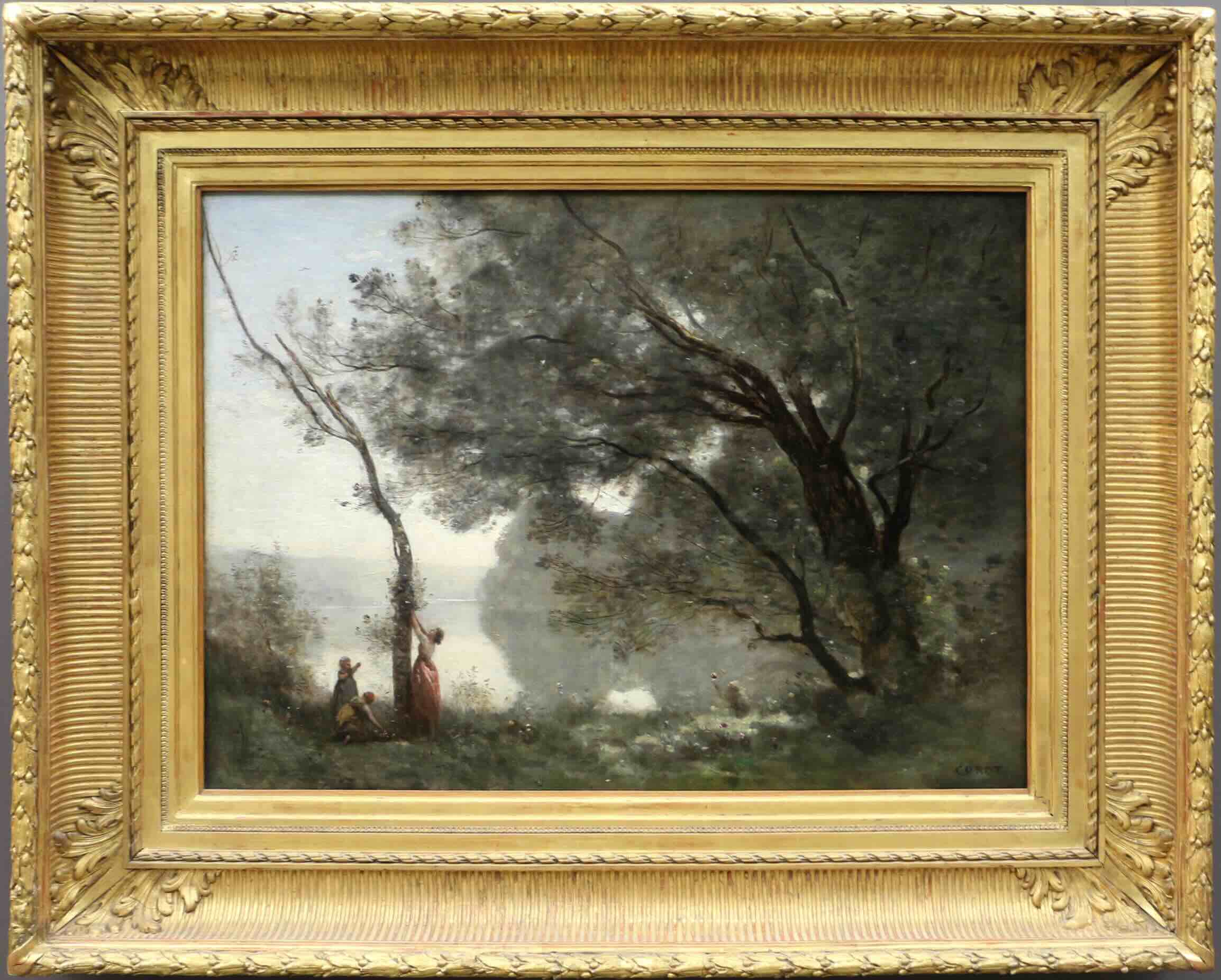
Jean-Baptiste-Camille Corot, Souvenir of Mortefontaine, 1864. Musée du Louvre, Paris
A souvenir, not a view
Mortefontaine is a village north of Paris, with ponds and woods where Corot liked to paint. But this isn't a faithful picture of any particular spot. In French, souvenir means memory, and Corot painted it in his studio, from many walks, many sketches, many mornings blended together.
It was shown at the Salon of 1864 and bought by Emperor Napoleon III. It has been in the Louvre ever since.
Memory as a painter
Our memories work a little like Corot's brush. They soften the edges, keep the light, lose the details that didn't matter, and sometimes gather several moments into one. That isn't a flaw. It's how we keep what we loved.
Paint a memory, in your mind
- Close your eyes and think of a place you loved: a garden, a beach, a street from your childhood.
- Don't try to remember everything. Let the picture come in soft focus, the way Corot paints.
- Notice what stays clear. A colour? A sound? The temperature of the air?
- Notice what has faded. Let it stay faded.
- Breathe in the light of that place for a few breaths. Then open your eyes and write down three words to keep it.
If this speaks to you, read whether we change a memory every time we remember it, or these paintings for when you miss something you can't name.
Keep your own souvenirs
The Collector's Diary is a free printable zine for remembering your encounters with art: where you met a painting, what you noticed first, and how it made you feel.
Remember to take as much time as you need, and meet me at the next one.
Love, Evi