
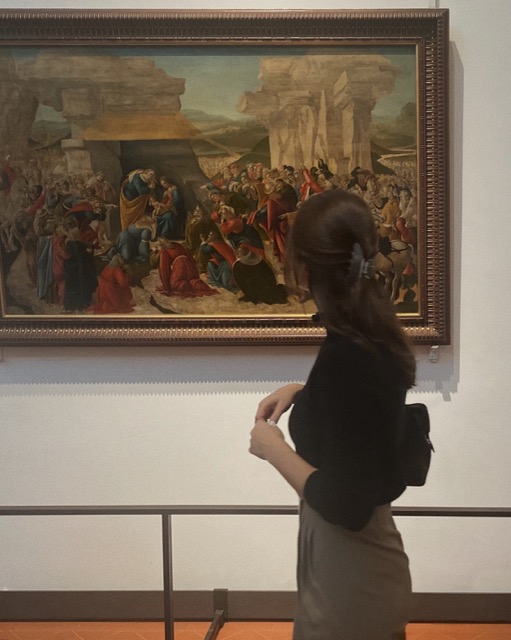
Most of us walk through a museum the way we scroll: a glance, a half-thought, next. When researchers timed visitors at the Metropolitan Museum of Art in New York, the average stop in front of a work of art lasted less than half a minute, and that included reading the label.
It isn't a lack of curiosity. Nobody ever taught us what to do once we're standing there. Ten minutes in front of one painting sounds endless when you don't know where to put your attention. With a little structure, it goes by surprisingly fast.
Here's a simple sequence to follow. It works in a museum, and it works on a screen too (in person is ideal, but a screen is better than nothing).
Before you start: choose one painting
Pick something with enough happening in it: a crowded still life, a busy street, a room full of objects. If you need an idea, Gustave Caillebotte's The Floor Scrapers at the Musée d'Orsay is a wonderful place to begin. Three men on their knees plane a wooden floor, curls of wood gather around them, and light pours in from a balcony window.
Don't read the label yet. We'll come back to it.
Minutes 1 to 2: arrive
Take three slow breaths before you look properly. Then let your eyes go wherever they want. Notice where they land first, and where they go next. That path is yours. Nobody else sees the painting in quite that order.
Minutes 3 to 4: find one detail
Now choose a single detail and look at it as if it existed on its own, outside the painting. In The Floor Scrapers, it could be one curl of wood, the bottle of wine waiting on the floor, or the pattern of the iron balcony. Stay with it. What shape is it, really? Where does the light touch it? If you cut it out and framed it, would it still be beautiful?
Minutes 5 to 6: listen
Ask yourself what you would hear if you stepped inside the painting. The scrape of the blades, a cart in the street below, someone breathing hard. Then the smell, the temperature, the texture of the floor under your knees. Sight is the way in, but the other senses are what make you stay.
Minutes 7 to 8: before and after
Every painting is a frozen second. What happened just before this moment? What will happen just after? Who are these men when no one is painting them? You don't need the right answer. You're practicing staying curious about something that doesn't move.
Minute 9: read the label
Now read it, and notice what changes. You might learn that this painting was turned down by the official Salon of 1875, reportedly because some found working men on their knees too vulgar a subject. Does it look different to you now? Sometimes the story deepens what you saw. Sometimes it quietly takes over. Both are interesting.
Minute 10: one word
Close your eyes and see the painting from memory. Then choose one word for what it made you feel, and write it down: on your phone, on the back of your ticket, in a notebook. That word is your souvenir. It will bring the painting back long after the details fade.
Why this works
Ten minutes of looking is a meditation in disguise. Your attention has somewhere to rest, your breath slows, and for a few minutes nothing is asking anything of you. You leave having seen fewer paintings, and remembering far more.
If you'd like a reason to practice this every month, that's exactly what the Letter & Magazine subscription is for: a letter and a postcard in your mailbox every month, and a quarterly magazine, "(meditating) On Art", with a Slow Art column built around one artwork and a new way of looking at it. Something to sit with, away from the screen.
Remember to take as much time as you need, and meet me at the next one.
Love, Evi