More time. More money. One more course, one more trip, one more thing before you can finally relax. The fear of not having enough can make us hold on to what no longer fits, or spend what we have as fast as it comes, because who knows if there'll be more.
Underneath, it's often one quiet question: am I enough to deserve good things?
Dutch painters in the 1600s spent a great deal of time on this question. They just asked it with objects.
A table of everything
In 1628, in Haarlem, Pieter Claesz painted a table covered with nearly everything a cultured life could hold. A small copy of the Spinario, the famous ancient statue of a boy pulling a thorn from his foot. Books and papers. A painter's palette and brushes. A glass. A pocket watch. On the floor, a violin, a lute, a recorder, a breastplate and helmet, a sketchbook open on a drawing.
And in the middle of it all, a skull.
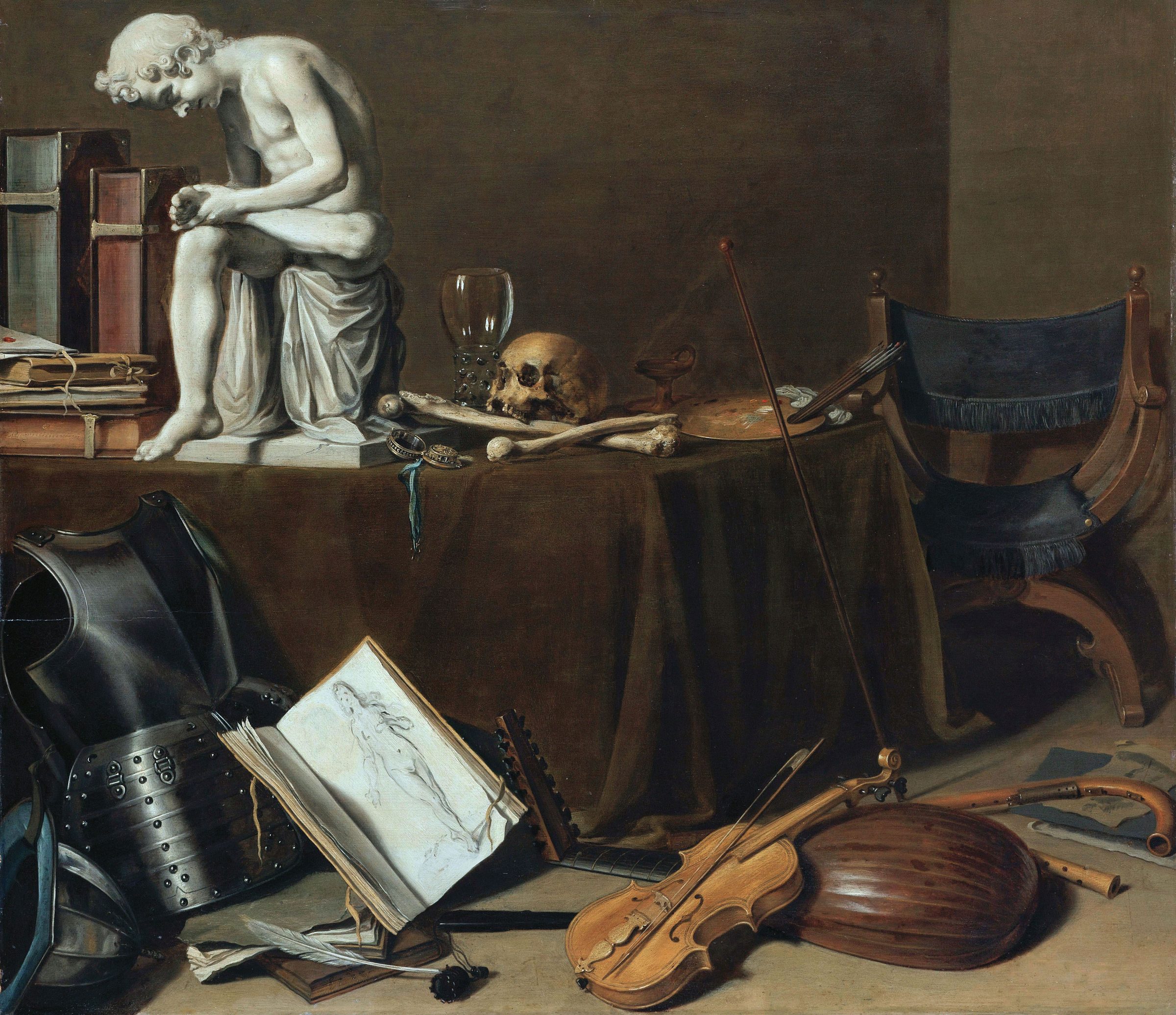
Pieter Claesz, Vanitas Still Life with the Spinario, 1628. Rijksmuseum, Amsterdam
What a vanitas is saying
These paintings are called vanitas, from a line in Ecclesiastes: "vanity of vanities, all is vanity". The message sounds grim: art, music, learning, glory, none of it lasts. But look again at how lovingly Claesz painted each thing. The curve of the lute, the light on the glass, the soft paper of the sketchbook.
Perhaps the lesson isn't "nothing matters". Perhaps it's "this is already here; notice it while it is". (For more about the symbols, here's what a still life is really saying.)
A practice for the "not enough" feeling
- Sit somewhere you spend time every day. Look around slowly.
- Name, silently, five things in the room that you're glad exist. A cup, a book, a plant, a coat, the light.
- Choose one and look at it the way Claesz would: its shape, its texture, where the light touches it.
- Ask yourself: if this were the only thing I received today, would it be enough for one moment? Let the answer be whatever it is.
- Close your eyes for three breaths. Then carry on.
You might like to make it a habit: a beauty list instead of a gratitude list.
Something that arrives without asking
"(letters) On Art" brings a letter and a postcard to your door every month, with the seasonal printed issue of "(meditating) On Art". Not more, just something good, arriving regularly.
Remember to take as much time as you need, and meet me at the next one.
Love, Evi