
You sit down, close your eyes, and the building wakes up. Footsteps overhead. A scooter on the street. The dishwasher changing cycle. Someone in the next room asking where the charger is.
Most meditation advice assumes a quiet room. Most of us don't have one.
Silence was never the point
Meditation isn't really about silence. It's a practice of attention: resting on one thing and letting the rest go by. Noise only becomes a problem when we decide it shouldn't be there.
That said, there's no prize for suffering. If you own noise-cancelling headphones or earplugs, use them. Quiet music or rain sounds are perfectly good companions too.
A painting you can hear
Look at Gustave Caillebotte's The Floor Scrapers. Three men on their knees, shirtless, scraping an old parquet floor in a Paris apartment. Curls of wood gather around them. A bottle of wine waits by the wall. The light from the balcony slides across the boards.
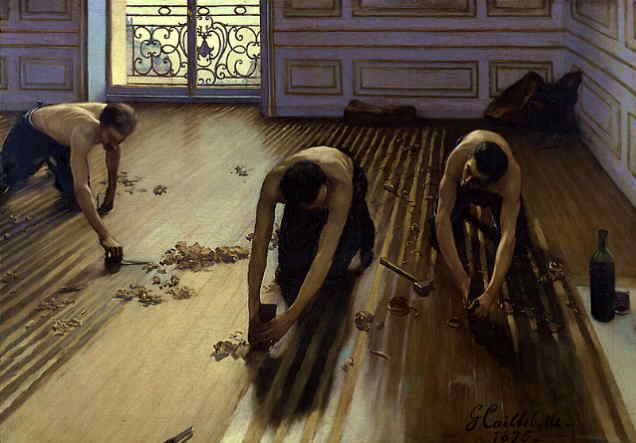
Gustave Caillebotte, The Floor Scrapers, 1875. Musée d'Orsay, Paris
The Salon of 1875 turned it down, partly because its subject seemed too ordinary. Yet it is one of the noisiest paintings you'll ever see in silence. You can almost hear the blades, the scrape and pause, a low conversation between strokes.
A five-minute listening meditation
- Look at the painting for a minute and "listen" to it. What would you hear if you stood in that room?
- Close your eyes. Now listen to your own room. Don't name anything as good or bad.
- Notice the sounds one by one, the way you might pick out instruments in an orchestra: the low hum, the rhythm, the sudden note.
- Let them layer. The fridge is the bass. The street is percussion. Your breath is the melody you return to.
- When a sound pulls you away, notice it, and come back to the breath.
You don't have to block the world out. You can let it become part of the music. (For one long piece of music instead, try deep listening.)
When you're never alone
If the people you live with are the noise, invite them in. Sit side by side for three minutes and listen together, no talking. Or take turns choosing a sound in the room and following it until it fades. It becomes less lonely, and often more fun.
And when even that isn't possible, there's always the commute: here is a three-minute meditation for the metro.
A meditation you read, not hear
A written practice works wonderfully in a loud home: you can pause, reread, go at your own pace. The First Letter is a short sensory meditation on receiving a letter, to read slowly wherever you are, with a sample of our magazine "(meditating) On Art". It's free.
Remember to take as much time as you need, and meet me at the next one.
Love, Evi