It's evening on the main street of Kristiania, today's Oslo. The sky is still blue, the windows are lit, and a crowd in hats and coats walks straight towards us. Their faces are pale, almost masks, with round, staring eyes.
And far away, on the empty road, a single dark figure walks the other way.
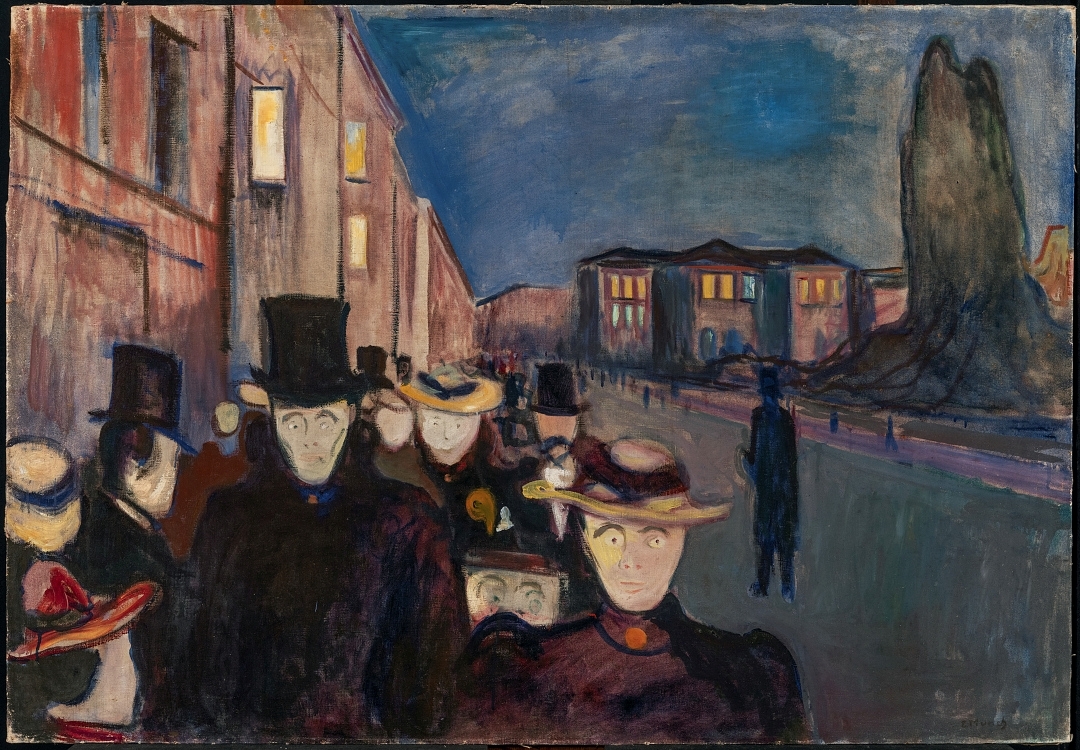
Edvard Munch, Evening on Karl Johan, 1892. KODE, Bergen
The year before The Scream
Munch painted this in 1892, the year before his most famous work. Karl Johans gate was the fashionable promenade of the city, where everyone went to see and be seen. Munch had walked it countless times.
But here, the stroll becomes something stranger. The crowd moves as one body. Nobody talks. The lone figure in the street is often read as Munch himself, set apart, going his own way. It's one of the first paintings that tries to show not what a street looks like, but how it can feel.
Alone in a crowd
Most of us know the feeling. A busy station, a packed shop in December, a party where everyone seems to know the rules except you. You're surrounded, and somehow on your own.
There's nothing wrong with you. Crowds are a lot for the nervous system. And sometimes walking the other way is exactly right.
A practice for crowded places
- When you feel the crowd pressing in, find something solid: a wall, a pillar, a shop window. Stand beside it.
- Feel your feet. Press them gently into the ground.
- Breathe out for longer than you breathe in, three times.
- Choose one point of colour in the distance, like the lit windows in Munch's painting. Rest your eyes on it.
- When you move again, choose your own pace. Going slower than the crowd is allowed.
For more, here are paintings that understand loneliness in a crowd and a three-minute meditation for the metro.
Your own pace
"(letters) On Art" brings each issue of "(meditating) On Art", with stories and slow-looking practices like this one, and a letter every month to help you keep your own pace.
Remember to take as much time as you need, and meet me at the next one.
Love, Evi