The watering can is already full. The work can wait a moment. A young woman leans against the stone of the well, and a little girl in a blue smock stands in front of her, one hand at her mouth, as if she's just asked a question.
Nothing else happens. That's the whole painting, and it's enough.
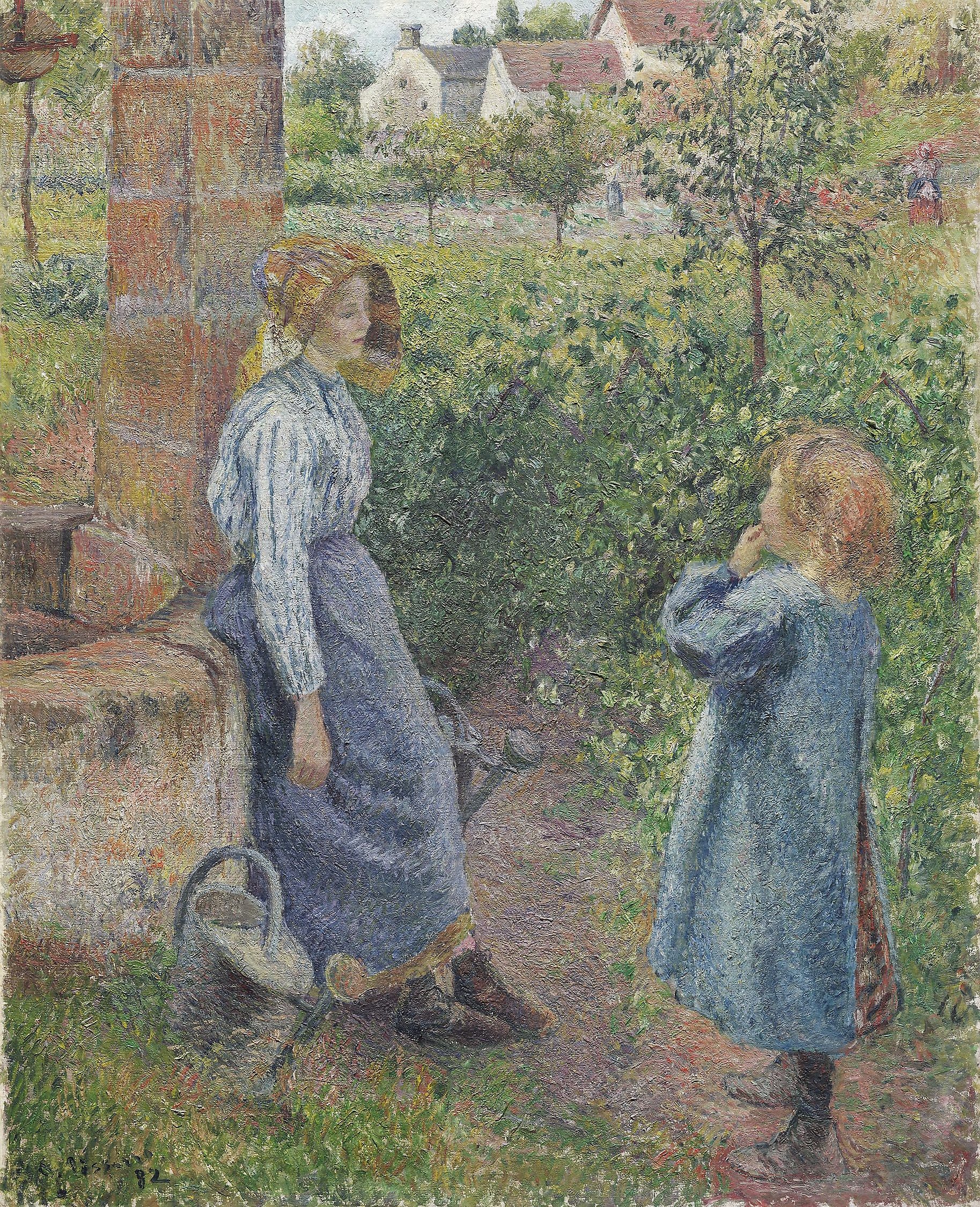
Camille Pissarro, Young Woman and Child at the Well, 1882. The Art Institute of Chicago
Pissarro's ordinary days
Camille Pissarro, often called the father of Impressionism, spent much of his life in the villages north-west of Paris, painting fields, kitchen gardens and the people who worked in them. Around 1880 he turned more and more towards figures: women resting, girls sewing, children in orchards. Not heroes, not stories. Just the pauses inside a working day.
Look at how he paints them: thousands of small, woven strokes of blue, lilac, green and gold, so that the figures seem made of the same light as the garden.
A guide for looking, not a guided meditation
Read each step, then look for as long as you like before moving on.
- Sit comfortably. Close your eyes and take three slow breaths. Relax your forehead, your jaw, your tongue.
- Open your eyes softly, as if just waking up. Look at the whole painting without naming anything.
- Notice the colours. The blues of the girl's smock, the lilac in the woman's skirt, the bright patches of green behind them.
- Now the figures. Imagine you're standing by the well. Feel the cool stone under your hand. Hear the water, the leaves, a bird somewhere in the orchard.
- What might the little girl be asking? You don't need to answer. Let the question hang in the air, the way it does in the painting.
- Look at the background: the trees, the roofs of the village, the light falling on them.
- Close your eyes and see the painting in your mind. Then sit in silence for a few breaths.
That silence is part of the practice. Let it be as long as it wants to be.
For more ways in, try how to look at one painting for ten minutes, or these paintings that give you permission to rest.
Slow looking, all year
"(letters) On Art" brings each issue of "(meditating) On Art", with practices like this one, and a letter and a postcard every month in between.
Remember to take as much time as you need, and meet me at the next one.
Love, Evi