Monday. The same train, the same inbox, the same lunch. By Friday the laundry basket is full again, and on Sunday evening you can already feel the shape of the next week waiting.
The ancient Greeks had a man for this feeling.
The boulder that always rolls back
Sisyphus, king of Corinth, tricked the gods once too often. His punishment in the underworld was to push an enormous boulder up a hill, again and again. Each time he neared the top, it rolled back down, and he had to begin once more. Forever.
Between 1548 and 1549, Titian painted him for Mary of Hungary, as part of a series of four condemned figures for her palace at Binche. His Sisyphus is huge and bent double, the rock pressing on his shoulders, flames and darkness all around. It's a painting about effort without end.
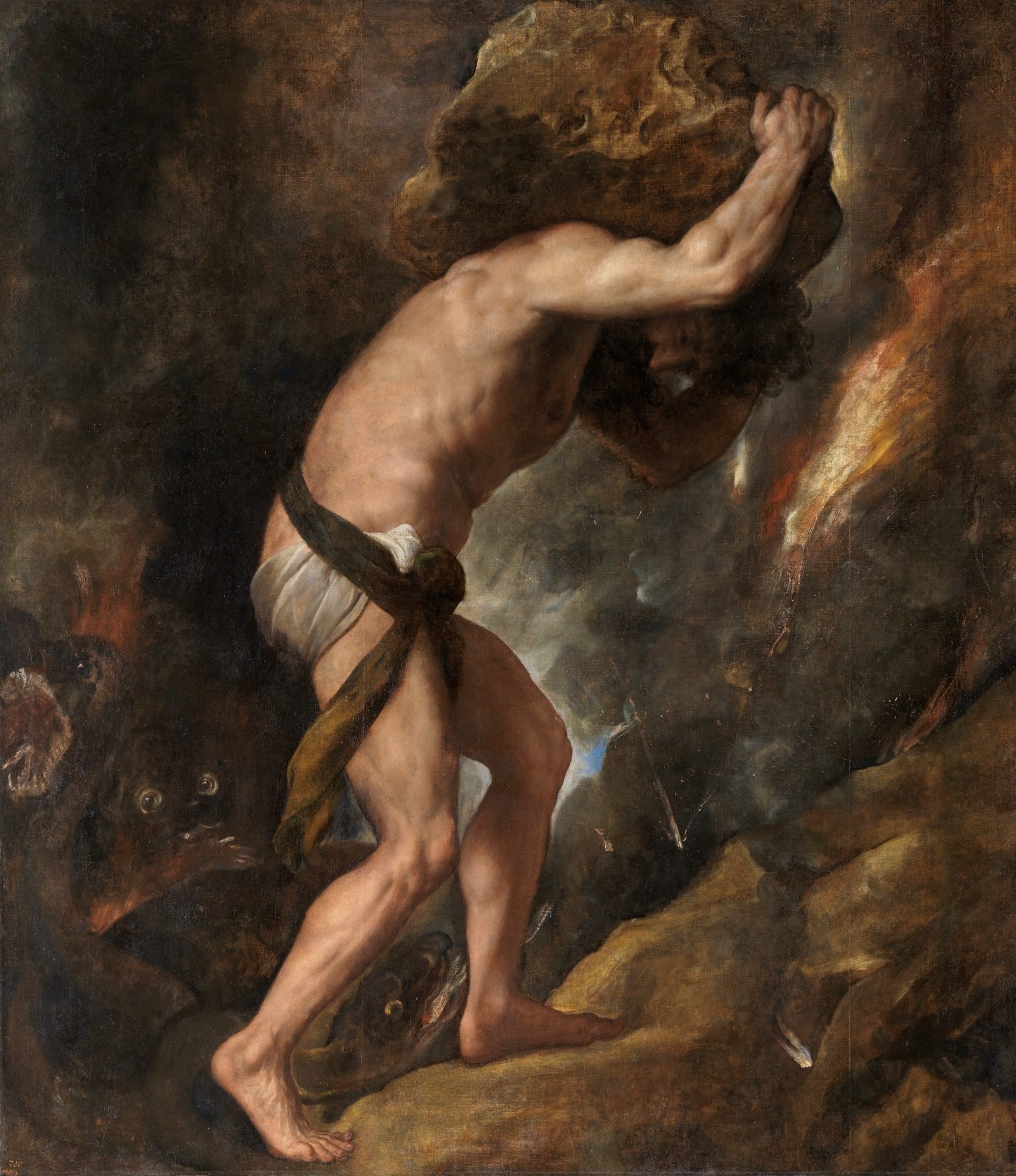
Titian, Sisyphus, 1548–1549. Museo Nacional del Prado, Madrid
Then Camus changed the ending
Four centuries later, in his 1942 essay The Myth of Sisyphus, Albert Camus looked at the same story and saw something else. What interested him was the moment Sisyphus turns and walks back down the hill to fetch his rock. Unhurried. Clear-eyed. Knowing exactly what awaits him.
His conclusion is one of the most quoted lines in philosophy: "One must imagine Sisyphus happy."
Not because the task becomes meaningful. Because he chooses how to carry it.
The walk back down the hill
Most of our repeated tasks have a walk back down: the moment after you've closed the laptop, the stairs after you've taken out the rubbish, the platform after the train has left. We usually spend it rushing towards the next thing.
Try this, once a day this week:
- Choose one moment that repeats. The walk to the metro, the kettle boiling, washing the same cups.
- When it comes, slow down by half. Literally: walk more slowly, pour more slowly.
- Notice three things: one sound, one colour, one sensation in your body.
- Don't try to enjoy it. Just be fully there for it.
Sometimes the boulder doesn't get lighter. But the way back down becomes yours. Here's more on why boredom is good for you, and on the art of doing one thing at a time.
Something that breaks the loop, gently
The First Letter is a short sensory meditation on receiving a letter, with a sample of our magazine "(meditating) On Art". It's free, and it's a small change in the shape of an ordinary week.
Remember to take as much time as you need, and meet me at the next one.
Love, Evi