You know that first morning after snowfall, when you open the window and the city sounds different? Footsteps are softer, cars are farther away, and the silence seems to have texture. Fresh snow really does absorb sound.
Monet painted that silence.
A field in Normandy
In the winter of 1868 to 1869, Claude Monet was living near Étretat, on the Normandy coast. He went out into the cold to paint directly from the landscape: a wattle fence, a little gate, a row of houses half hidden by snowy trees. On the gate, a single magpie.
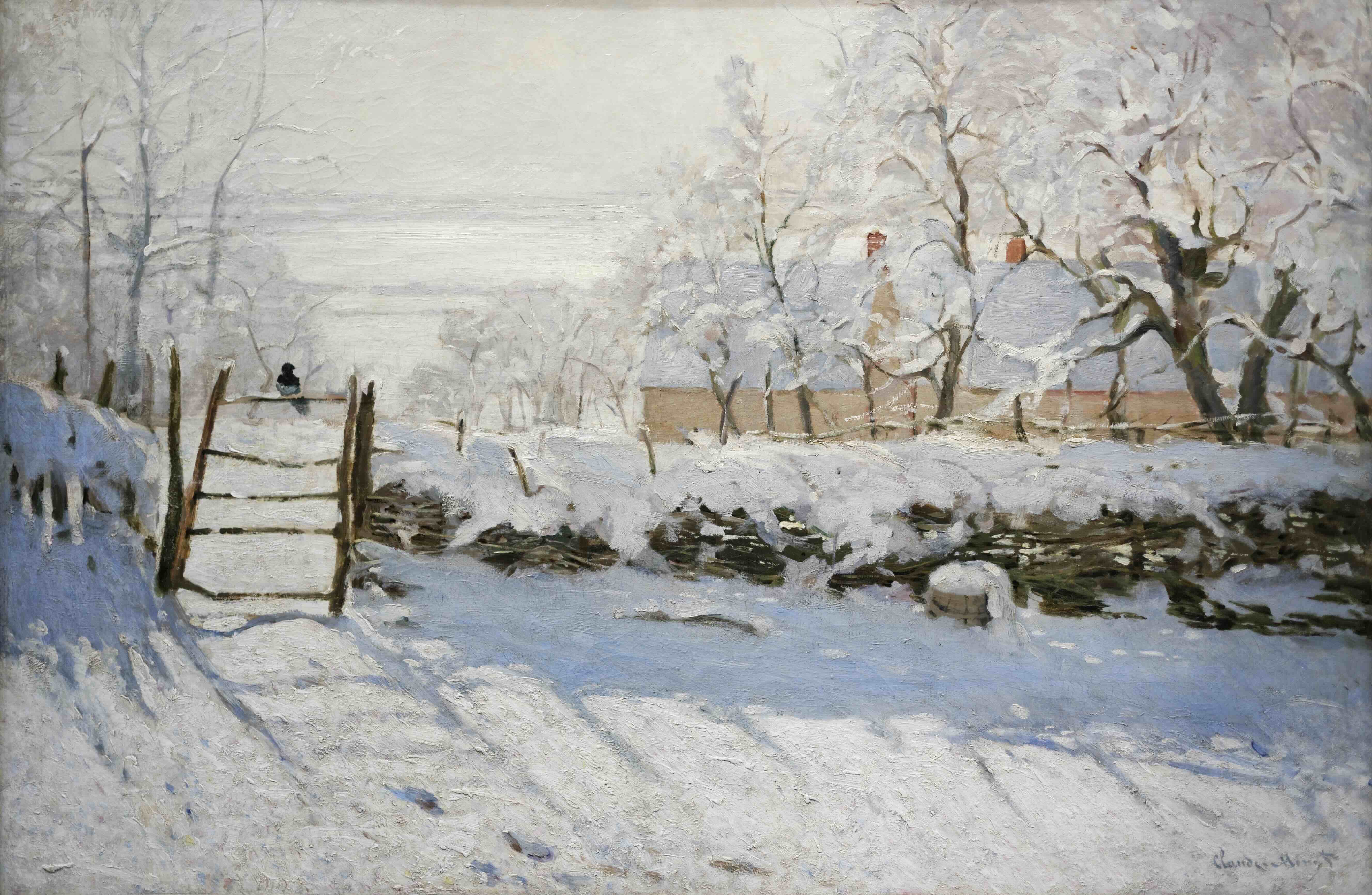
Claude Monet, The Magpie, 1868–1869. Musée d'Orsay, Paris
Look at the shadows the fence throws across the snow. They aren't grey. They're blue and lilac, because snow reflects the colour of the sky. (Monet and his friends made a whole practice of this; here's how the Impressionists painted snow.)
Too bold for its time
Monet submitted The Magpie to the Salon of 1869. The jury rejected it. Its coloured shadows and its vast bright whiteness seemed too unconventional for an official exhibition. Today it is one of the most loved paintings at the Musée d'Orsay, and many visitors stop in front of it longer than they planned to.
One small dark note
The whole painting is light, except for one detail: the bird. Small, black, slightly off-centre. Your eye goes to it again and again, the way your ear goes to a single sound in a silent room.
A listening meditation with The Magpie
- Look at the whole painting for a minute. Imagine stepping into that field. Hear the crunch under your feet.
- Now stop moving. What would you hear? Almost nothing. Perhaps a branch letting go of its snow. Perhaps a wing.
- Let your eyes follow the shadows from the gate across the snow. Name their colours silently.
- Return to the magpie. Imagine it is about to fly. Stay with the moment just before it does.
- Close your eyes and listen to the room you're in. Find its quietest sound and rest there for a few breaths.
If your home is rarely this quiet, here's how to meditate with the noise, not against it.
Something for the quiet months
"(letters) On Art" brings this kind of slow looking to your mailbox: a letter and a postcard every month, and each season the printed issue of "(meditating) On Art". A little company for the winter.
Remember to take as much time as you need, and meet me at the next one.
Love, Evi