Ask most people to name a Greek painter and they'll pause, then say El Greco, who left Crete young and made his name in Spain. Fewer would name Nikolaos Gyzis. Yet in late 19th-century Munich, he was one of the most respected painters in the city.
From a marble island to Munich
Gyzis was born in 1842 in Sklavochori, a village on Tinos, a Cycladic island known for its marble and its sculptors. He studied in Athens, then in 1865 won a scholarship to the Academy of Fine Arts in Munich. He stayed for the rest of his life, became a professor at the Academy in 1886, and taught students from across Europe.
He's remembered as the leading figure of what Greeks call the Munich School: painters trained in Germany who brought back a rich, dark, academic style. His early pictures are scenes of daily life, often tender and funny: children, families, a carnival in Athens.
Then the light changed
In the 1890s, his work turned towards something more spiritual. Figures dissolve. Light seems to come from inside the canvas.
One of his last major paintings takes its title from a hymn sung during Greek Orthodox Holy Week, Behold the Bridegroom Arriving. A vast arch of glowing red and gold, angels lining the way, a figure of light at the end of a long staircase.
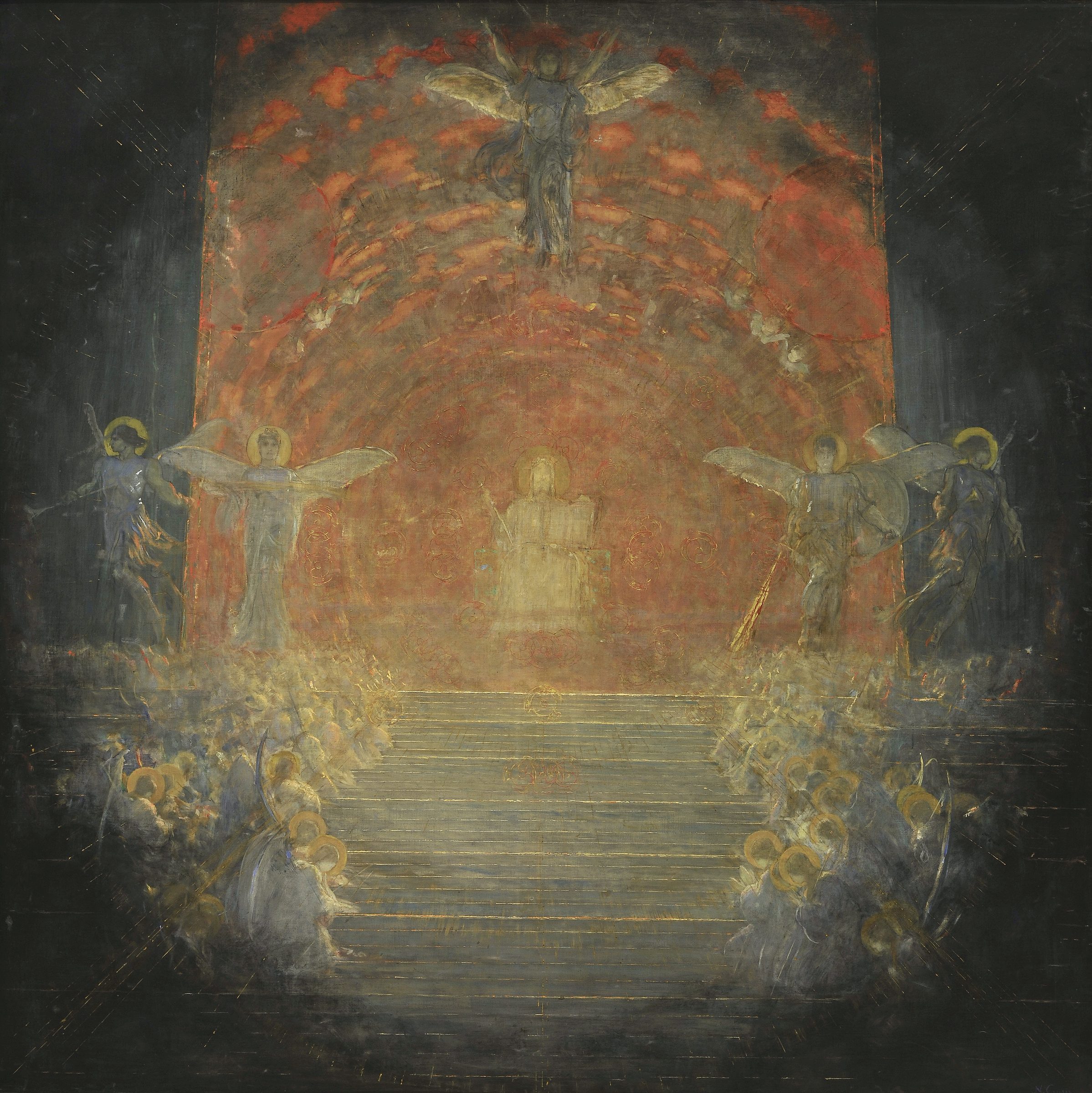
Nikolaos Gyzis, Behold the Bridegroom Arriving, 1899–1900. National Gallery, Athens
How to look at a painting full of light
You don't need to share its faith to feel what it's doing.
- Look at the painting for a minute, as a whole. Let it be mostly colour.
- Find the brightest point. Rest your gaze there for three breaths.
- Now find the darkest corner. Rest there for three breaths.
- Let your eyes travel slowly from the darkness up the staircase towards the light, as if you were climbing it.
- Close your eyes. Notice whether any of that warmth stays with you.
Some paintings ask to be understood. This one asks to be stood in front of. If it reminds you of another painter who turned towards the spiritual, read about Hilma af Klint's hidden paintings, or meet the nine Muses.
Art, by post
"(letters) On Art" brings a letter and a postcard every month, and each season the printed issue of "(meditating) On Art", with stories of painters, famous and forgotten.
Remember to take as much time as you need, and meet me at the next one.
Love, Evi