
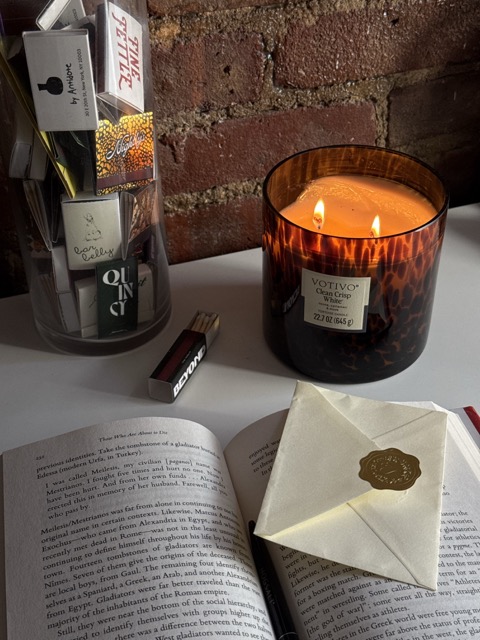
The paper is ready. The pen is uncapped. You've even made tea. And then: nothing. "Dear…" and a long, empty silence.
Most of us don't struggle with letters because we have nothing to say. We struggle because a letter feels like it should be important, like it needs news, or a reason. It doesn't. The letters people keep for years are rarely the ones with big announcements. They're the ones that feel like sitting across the table from you.
Here are 20 prompts to get you there. You don't need all of them. Pick two or three, and let the letter wander.
To begin
1. Describe where you're writing from right now, as if they could see it: the light, the sounds, what's on the table. 2. Tell them what made you think of them this week. 3. Start in the middle: "So, I have to tell you about the pigeon on my balcony…" 4. Describe the weather the way you'd describe a mood.
About your everyday
5. What small thing has been giving you joy lately? A song, a snack, a new way home. 6. What's on your bedside table, and are you actually reading it? 7. Describe one ordinary moment from this week, in slow motion. 8. What question has someone asked you recently that you're still thinking about? (My son brings up the meaning of life at breakfast. I'm still answering him.)
About the two of you
9. Share a memory you both have that they might have forgotten. 10. What's something they taught you without knowing it? 11. What would you do together if they were here this weekend? 12. Describe them the way a painter would: one color, one gesture, one object.
About the deeper things
13. What are you learning to let go of? 14. What has changed in you this year, and what has stayed the same? 15. What are you looking forward to, even something tiny? 16. Is there something you've never quite said to them? You can say a small part of it here.
To close
17. Ask them a question you genuinely want answered. 18. Recommend one thing: a book, a film, a walk, a recipe. 19. Tell them how you hope their week feels. 20. Add a postscript. A P.S. has a way of becoming the part people reread.
A few gentle rules
Write by hand if you can. Don't edit too much; crossed-out words are part of the charm. And don't wait for the perfect letter. An imperfect letter that arrives is worth more than a perfect one that stays in your head.
Before you write one, receive one
If you've forgotten what it feels like to open a letter, start there. The First Letter is a short sensory meditation on receiving one. You can read it or listen to it, and it comes with a sample of my magazine, "(meditating) On Art". It's free, and it might be exactly what gets your pen moving again.
Remember to take as much time as you need, and meet me at the next one.
Love, Evi